Making Content Until You Break: The Hidden Burnout Crisis Swallowing Creators Whole
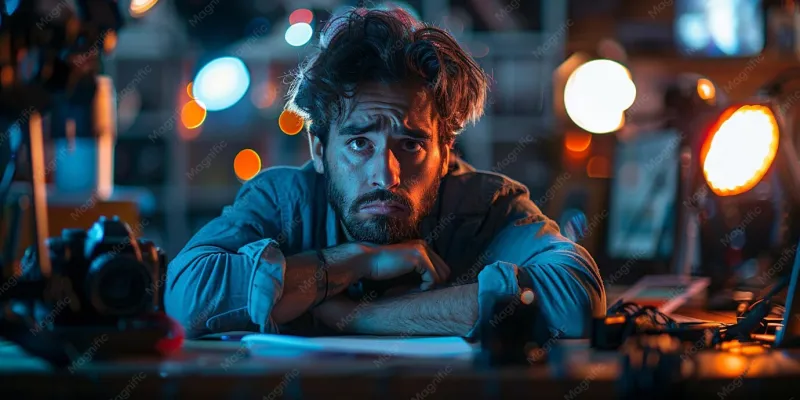
Photo: exhausted young content creator sitting alone with camera and laptop looking stressed, via img.freepik.com
Somewhere between the ring light and the ring light, a creator decides they can't do it anymore.
Maybe you've noticed it — a YouTube channel that went dark after years of consistent uploads, a TikToker whose once-chaotic energy now reads as hollow, an Instagram creator who posts less and less until one day they just... don't. The official statement, when it comes, usually includes words like "mental health," "stepping back," and "grateful for the journey." What it rarely includes is the truth: the content economy chewed them up and left very little behind.
This is the attention recession nobody's officially naming yet. And it's reshaping who gets to have a creative career in 2024 — and who quietly disappears.
The Hamster Wheel That Never Slows Down
Here's the thing most casual viewers don't fully clock: being a creator isn't a job that ends. There's no clocking out. The algorithm doesn't care that you filmed for twelve hours yesterday or that your grandmother passed away or that you're running a fever. What it cares about is whether you posted today — and whether today's post performed.
For mid-tier creators — the ones with, say, 100,000 to 800,000 followers, which sounds impressive until you learn what it actually pays — this pressure hits especially hard. They're big enough to have audience expectations, but not big enough to have a team, a manager, or a safety net. They're doing their own editing, their own brand outreach, their own analytics, their own customer service. And they're doing all of it while also trying to, you know, be creative.
The economics make this worse in ways that don't get talked about enough. Ad revenue on most platforms fluctuates wildly. Brand deals dry up the moment your engagement dips. YouTube's monetization thresholds mean a bad quarter can wipe out months of income. Creators aren't just making content — they're running small businesses with completely unpredictable revenue streams, often while pretending everything's fine on camera.
The Algorithm as Anxiety Machine
If you've spent any time in creator communities — the subreddits, the Discord servers, the comment sections where people are brutally honest — you'll notice one topic comes up constantly: the algorithm. Not as a neutral tool, but as something closer to a capricious boss who changes the rules without warning and never explains why.
A creator can spend weeks building a content strategy, study what's working, optimize thumbnails, adjust posting times — and then watch a random video they made in twenty minutes outperform everything. Or they can pour genuine effort and craft into something they're proud of and watch it flatline. The unpredictability isn't a bug; it's essentially a feature that keeps creators posting more, trying more, chasing the next hit.
Psychologists would recognize this pattern immediately. Variable reward schedules — where the payoff is inconsistent and unpredictable — are among the most powerful behavioral reinforcers we know of. It's the same mechanism behind slot machines. Creators aren't just making content; they're pulling a lever over and over, hoping this time it lands.
That kind of sustained uncertainty is genuinely exhausting. And when your livelihood depends on it, the anxiety doesn't stay at the desk — it follows you everywhere.
When 'Going Viral' Becomes a Trap
There's a particular cruelty in what happens after a creator's breakout moment. The audience that found them expects more of whatever made them pop. The algorithm rewards content that mimics the hit. Brands come calling with deals tied to that specific version of the creator. And suddenly, someone who maybe wanted to explore multiple creative directions is locked into a single lane — forever the person who does that thing, that way, on that schedule.
Several prominent creators have talked openly about this feeling of creative imprisonment. You built an audience on a version of yourself, and now that version of yourself has to show up every single day, whether you feel it or not. The authenticity that made you compelling becomes a performance of authenticity. And performing authenticity, it turns out, is one of the most exhausting acts there is.
The creators who make it long-term — your MrBeasts, your Emma Chamberlains — often talk about pivoting, evolving, building teams, and treating their work like a business from day one. That's legitimate advice. It's also advice that requires capital, luck, and timing that most creators simply don't have access to.
What Disappearing Actually Looks Like
Burnout in the creator world rarely looks like a dramatic meltdown. More often, it looks like gradual withdrawal. Posting frequency drops. Video quality stays the same but the energy feels different — flatter, more mechanical. The creator starts apologizing in their content for not posting enough. Then they post an emotional video about needing a break. Then the break extends. Then they're gone.
For audiences, this can feel confusing or even like a betrayal. For creators, it often comes after months of quietly falling apart while maintaining a public face. The comment sections don't see the 3 a.m. editing sessions, the panic attacks before posting, the obsessive checking of analytics every hour, the dread that builds every Sunday when Monday's content isn't ready.
Mental health professionals who work with creators have noted that many of their clients struggle to separate their sense of self-worth from their performance metrics. When the numbers go down, they feel like they're going down. That's not a personal failing — it's what happens when your identity and your income are both tied to a public approval rating that updates in real time.
Is There a Sustainable Version of This?
Some creators are starting to push back — quietly, mostly, but it's happening. There's been a slow shift toward longer-form content that doesn't demand daily output, toward Patreon and subscription models that create more stable income, toward newsletters and podcasts where the algorithmic pressure is slightly less brutal. Some are being deliberately transparent with their audiences about the unsustainability of the current model.
There's also a broader cultural conversation starting to form — not just about creator wellness, but about what audiences actually owe the people they follow. The parasocial relationship between creator and viewer is built on a kind of invisible contract: I'll give you my time, my humor, my vulnerability, my consistency. You give me your attention. But that contract has never been written down, and it's almost entirely one-sided.
The attention economy rewards volume and consistency above almost everything else. Until that changes — until platforms restructure their incentives, until audiences recalibrate their expectations, until the economics shift in ways that let creators breathe — the burnout pipeline isn't going anywhere.
Somewhere right now, someone is filming their fourth video of the week, exhausted, wondering if this is sustainable. The answer, increasingly, is no. The question is whether anyone with actual power in this ecosystem cares enough to do something about it — or whether the content just keeps coming until the person making it finally stops.